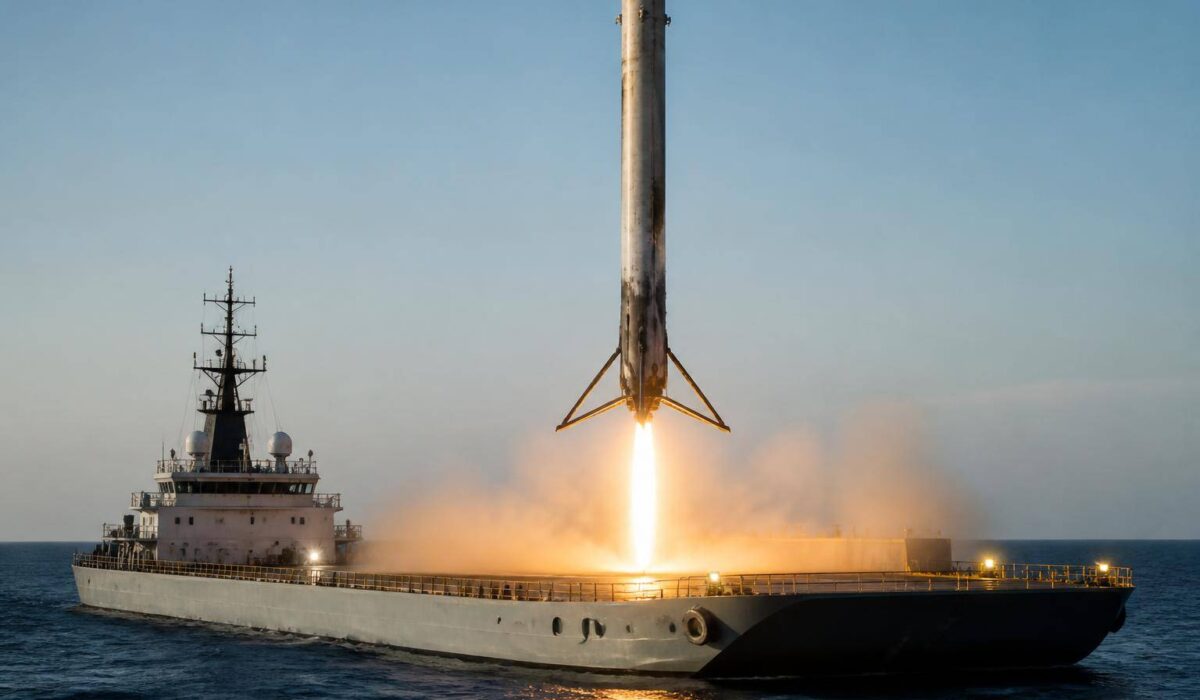
China has made a significant leap in space technology by successfully testing an experimental rocket retrieval system. This system utilizes a net attached to a sea platform, aiming to enhance China’s capabilities in reusable rockets and reduce reliance on foreign technology.
The test took place on Friday, with the Long March 10B rocket launching from the Hainan commercial space launch site at 12:15 PM local time. Approximately six minutes post-launch, the rocket’s booster separated and returned vertically to be recovered on an offshore platform, as reported by state media. This achievement marks China’s first successful retrieval of an orbital-class rocket, bringing the nation closer to developing fully reusable rockets.
Details of the Long March 10B Rocket
The Long March 10B rocket is a significant development in China’s commercial aerospace sector, designed by the China Academy of Launch Vehicle Technology (CALT). It is capable of carrying payloads of at least 16 metric tons to low-Earth orbit. This rocket has been compared to SpaceX’s Falcon 9, which is widely used for various satellite launches.
However, the Long March 10B employs a different recovery method. Instead of autonomously landing on a ground pad or drone ship like the Falcon 9, it utilizes four landing hooks to catch a net attached to a sea platform. This innovative approach simplifies the rocket’s structure, reduces its mass, and increases its payload capacity.
Implications for China’s Space Program
The successful test is a crucial step for China, which has invested nearly a decade in developing reusable rocket technologies. This includes a range of tests from low-altitude hovers to more complex orbital-class booster recovery attempts. The establishment of a reliable reusable rocket system is expected to significantly lower launch costs, which is vital for China’s expanding commercial satellite constellations.
Additionally, the Long March 10B is part of a broader initiative aimed at supporting China’s crewed lunar missions planned for before 2030. The data and technologies validated through this rocket will be instrumental for future lunar exploration efforts.
Market Response and Future Plans
The news of the successful test has positively impacted the stock market, with shares in Chinese aerospace firms, such as China Spacesat and China Satellite Communications, reaching daily limits. This reflects investor confidence in the potential of China’s space program and its commercial viability.
Looking ahead, China plans to utilize the Long March 10B’s booster stage for another launch by the end of this year, further demonstrating its commitment to advancing its space capabilities.
Global Competition in Reusable Rocket Technology
The race for reusable rocket technology is intensifying globally, with companies like SpaceX leading the charge. SpaceX’s Falcon 9 has successfully completed around 150 launches annually, showcasing the efficiency and economic benefits of reusing rocket boosters. In contrast, China’s efforts are gaining momentum, with private firms also stepping up their initiatives to develop reusable rockets.
Last year, two attempts by private Chinese firms, LandSpace and the state-owned China Aerospace Science and Technology Corporation, to recover boosters ended in failure. However, the recent success of the Long March 10B indicates a promising future for China’s ambitions in this competitive field.
Technological Innovations in Rocket Recovery
- Net-based recovery simplifies onboard structures.
- Increases payload capacity and adaptability to landing-point deviations.
- Utilizes four landing hooks for recovery on a sea platform.
Experts from CALT have emphasized that this net-based recovery system not only enhances the rocket’s efficiency but also broadens the potential for capturing rockets in varying conditions.
As China continues to develop its space technology, the successful testing of the Long March 10B’s recovery system is a pivotal moment that could redefine the landscape of global space exploration and commercial satellite launches.